Protect Your Smile with Advanced Oral Cancer Screening
Let me ask you something: When was the last time you really thought about the health of your mouth beyond just brushing and flossing? If you’re like most people, oral cancer probably isn’t something that crosses your mind during your morning routine. And honestly? That’s completely normal. But here’s the thing—staying informed and proactive about your oral health could literally save your life.
Welcome to a conversation that matters. Today, we’re diving deep into why advanced oral cancer screening should be a non-negotiable part of your dental care routine. Whether you’re in your twenties, thirties, or beyond, this is for you. And don’t worry—I promise to keep things friendly, easy to understand, and free of any scary medical jargon.
We’re going to talk about what oral cancer actually is, who’s at risk (spoiler: it might surprise you), how modern screening works, and why choosing the right dental partner—like Tirupati Dental—makes all the difference in protecting your smile and your future.
So grab a cup of tea, get comfortable, and let’s protect that beautiful smile together.
What Exactly Is Oral Cancer? (And Why Should You Care?)
Let’s start with the basics. Oral cancer refers to any cancerous tissue growth located in the oral cavity. That includes your lips, tongue, cheeks, floor of the mouth, hard and soft palate, sinuses, and throat. It’s not just one disease—it’s a group of cancers that can develop in any of these areas.
Now, here’s why you should care. According to global health statistics, hundreds of thousands of people are diagnosed with oral cancer every year. And while that number sounds scary, here’s the hopeful part: when caught early, oral cancer has an excellent survival rate. We’re talking above 80-90% in many cases.
But here’s the challenge—early detection rarely happens on its own. Most people don’t notice the subtle early signs. That’s why regular, advanced oral cancer screening is absolutely vital.
High-ranking keywords to remember: oral cancer symptoms, early detection oral cancer, oral cavity examination, preventive dental care, mouth cancer risk factors
At Tirupati Dental, we’ve seen firsthand how a simple screening can change someone’s life. And we want that for you, too.
The Silent Truth: Oral Cancer Doesn’t Always Come with Warning Signs
Here’s something that might surprise you. Many people assume that if they had oral cancer, they’d know something was wrong. They think there would be pain, visible sores that won’t heal, or dramatic changes in their mouth.
But that’s not always the case.
In its earliest stages, oral cancer can be completely symptom-free. No pain. No obvious lumps. Nothing that would make you stop and think, “Hey, I should see a doctor.” That’s why it’s often called a silent threat. It develops quietly, sometimes over months or even years, without sending up any red flags you’d notice on your own.
This is precisely why waiting until you feel something wrong is a dangerous game. By the time symptoms become noticeable, the cancer may have already progressed to a later, harder-to-treat stage.
The team at Tirupati Dental believes in catching problems before they become problems. That’s the heart of preventive dentistry, and it’s exactly why we’re so passionate about advanced oral cancer screening.
Who Is at Risk? You Might Be Surprised
When most people think of oral cancer, they picture older adults with a long history of smoking or heavy drinking. And yes, those are significant risk factors. But the reality is much broader—and much more relevant to a younger audience.
Let’s break down the real risk factors for oral cancer today.
Traditional Risk Factors (Still Very Important)
- Tobacco use of any kind – cigarettes, cigars, pipes, chewing tobacco, snuff, and vaping products. This remains the number one cause.
- Heavy alcohol consumption – especially when combined with tobacco use, the risk multiplies dramatically.
- Prolonged sun exposure – increases risk for lip cancer.
- Poor nutrition – diets low in fruits and vegetables may increase susceptibility.
The Surprising Risk Factors (This Is Where It Gets Real for the 20+ Crowd)
Here’s what many people don’t know. Oral cancer is increasingly being linked to HPV (human papillomavirus) , specifically the HPV-16 strain. And HPV-related oral cancers are showing up in younger, otherwise healthy individuals who have never smoked or drunk heavily in their lives.
We’re talking about people in their twenties, thirties, and forties. Athletes. Professionals. Parents. People just like you.
HPV is incredibly common—most sexually active adults will contract some form of HPV in their lifetime. For most, the immune system clears it without issue. But for a small percentage, the virus can trigger cellular changes in the throat and mouth that lead to cancer years later.
This doesn’t mean you should panic. It means you should be proactive. And that starts with advanced screening at a trusted provider like Tirupati Dental.
Why Traditional Oral Exams Aren’t Enough Anymore
You’ve probably had a traditional oral cancer screening before without even realizing it. Your dentist looks inside your mouth, feels around your neck and jaw, and asks if you’ve noticed any unusual sores or lumps. That’s the standard visual and tactile exam.
And don’t get me wrong—that exam is valuable. It catches many obvious abnormalities. But here’s the honest truth: it’s not enough to catch everything.
Traditional exams rely on what the naked eye can see and what the fingers can feel. But precancerous changes and very early-stage cancerous cells often don’t create visible or palpable changes. They hide beneath the surface, invisible to conventional methods.
That’s where advanced oral cancer screening technology changes the game entirely.
At Tirupati Dental, we don’t settle for “good enough.” We use the most advanced screening tools available because your health deserves the verybest.
The Breakthrough: How Advanced Oral Cancer Screening Works
Let me walk you through what advanced oral cancer screening actually looks like. And I promise—it’s quick, painless, and totally non-invasive.
The Fluorescence Technology Approach
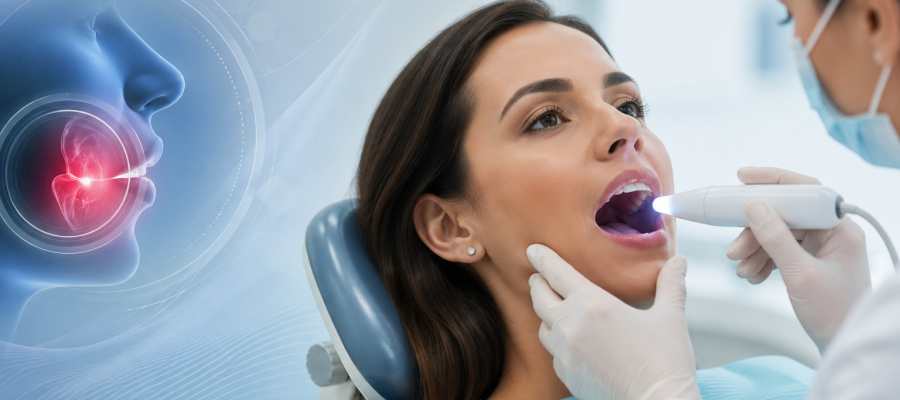
One of the most powerful tools in modern oral cancer screening is fluorescence technology. Devices like VELscope or OralID use a special blue light to illuminate the tissues in your mouth.
Here’s the science in plain English: Healthy oral tissues absorb this blue light and naturally fluoresce, appearing bright green under the special filter. But abnormal or dysplastic tissues—the kind that could become cancerous—lose this ability to fluoresce. Instead, they appear as dark spots against the bright background of healthy tissue.
It’s like having a special flashlight that makes problems literally glow in the dark so your dentist can see them immediately.
What This Technology Can Detect
- Dysplasia – abnormal cellular changes that are not yet cancerous but could become cancerous
- Hyperkeratosis – thickened tissue that may indicate chronic irritation or early changes
- Early-stage carcinomas – cancerous lesions that are still tiny and completely asymptomatic
- Precancerous spots – areas that need monitoring or biopsy before they progress
The Patient Experience (Super Simple)
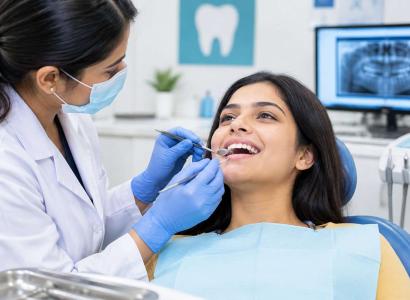
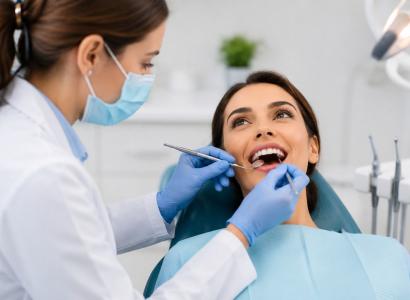
You sit in the dental chair. The dentist dims the lights. They shine the special light into your mouth and look through a viewing filter. They examine every surface—your tongue, cheeks, gums, floor of the mouth, and palate. The whole process takes about two to three minutes. No poking. No pain. No radiation. No discomfort whatsoever.
At Tirupati Dental, we’ve made this technology a standard part of our comprehensive oral evaluations because we believe everyone deserves this level of protection.
The Lifesaving Power of Early Detection (Real Talk)
Let me be completely honest with you. The difference between catching oral cancer early versus late is often the difference between a minor procedure and major surgery. Between preserving your smile and losing part of your jaw or tongue. Between a full recovery and a much harder fight.
Early-stage oral cancer (Stage I or II) typically requires a small surgical removal and has an excellent prognosis. Five-year survival rates exceed 80-90% for many types.
Late-stage oral cancer (Stage III or IV) may require extensive surgery, radiation, chemotherapy, or all three. Survival rates drop significantly. Quality of life during and after treatment is dramatically different.
This isn’t meant to scare you—it’s meant to empower you. Because you have control over this. You can choose to get screened. You can choose to catch things early. You can choose to protect your future self.
The team at Tirupati Dental has helped countless patients catch concerning findings at the earliest possible stage. Some of those findings turned out to be nothing—and what a relief that is! But the ones that did require intervention? Those patients are thriving today because they didn’t wait.
What Happens If Something Unusual Is Found?
Okay, let’s talk about the “what if.” Because knowing what to expect reduces anxiety and helps you make informed decisions.
If your advanced oral cancer screening reveals an area that looks suspicious—a dark spot under the fluorescence light or an area that doesn’t look quite right—your dentist will not immediately assume it’s cancer. In fact, most suspicious findings turn out to be completely benign!
Here’s the typical next step:
Step 1: Re-examination and Monitoring
Sometimes, the dentist will simply note the area and ask you to come back in a few weeks to see if it has changed. Many benign conditions resolve on their own.
Step 2: Referral for Biopsy
If the area remains suspicious, a biopsy is the gold standard for diagnosis. This is a simple procedure where a small sample of tissue is removed and sent to a lab for analysis. It sounds scarier than it is—usually done with local anesthesia in just a few minutes.
Step 3: Diagnosis and Next Steps
If the biopsy comes back positive for dysplasia or cancer, you’ll be referred to an oral surgeon or oncologist for treatment. The good news? At this early stage, treatment is typically less invasive and more successful.
At Tirupati Dental, we guide you through every step with compassion, clarity, and support. You’re never alone in this process.
How Often Should You Get Screened? A Simple Schedule
This is one of the most common questions we hear, and the answer depends on your personal risk factors.
For Most Adults (Ages 20+ with No Significant Risk Factors)
Once per year as part of your routine dental checkup is the standard recommendation. Your annual exam should always include an oral cancer screening.
For Higher-Risk Individuals
If you have any of these risk factors, consider screening every six months:
- Current or former tobacco user
- Heavy alcohol drinker
- Previous diagnosis of oral cancer or dysplasia
- Known HPV infection (especially HPV-16)
- Family history of oral cancer
- Chronic sun exposure (for lip cancer risk)
The Proactive Approach
Even if you don’t fall into a high-risk category, many experts now recommend asking for advanced fluorescence screening at least once every 12-18 months. The technology is so quick and affordable that the peace of mind alone is worth it.
At Tirupati Dental, we personalize every screening recommendation based on your unique health profile. No one-size-fits-all approach here.
The Connection Between Lifestyle and Oral Cancer Risk
While screening is your safety net, prevention is your first line of defense. Let’s talk about practical lifestyle changes that can dramatically reduce your oral cancer risk.
Tobacco Cessation (The Single Biggest Win)
If you use tobacco in any form, quitting is the most powerful thing you can do for your oral health. Within just a few years of quitting, your risk drops significantly. We know quitting is hard—but so is cancer treatment. Tirupati Dental can connect you with resources to help you quit for good.
Moderate Alcohol Consumption
Limiting alcohol to moderate levels (one drink per day for women, two for men) reduces your risk. If you drink heavily, cutting back makes a real difference.
HPV Vaccination
The HPV vaccine is approved for people up to age 45 and is highly effective at preventing the HPV strains most linked to oral and throat cancers. Talk to your doctor about whether the vaccine is right for you.
Sun Protection for Your Lips
Use lip balm with SPF, wear a wide-brimmed hat, and avoid peak sun hours. Your lips need protection just like the rest of your skin.
A Nutrient-Rich Diet
Foods rich in antioxidants—berries, leafy greens, cruciferous vegetables, and colorful fruits—support your body’s natural cancer-fighting abilities.
What About Vaping? Let’s Clear the Air
I get asked about this constantly, especially by younger patients. Is vaping safer than smoking when it comes to oral cancer?
The honest answer is that we don’t fully know yet. Vaping hasn’t been around long enough for long-term cancer studies to be completed. But early research is concerning.
What we do know:
- E-cigarette aerosols contain known carcinogens, including formaldehyde and acetaldehyde
- Vaping causes significant cellular stress in oral tissues
- Many vapers use nicotine salts that may be particularly irritating to mucosal surfaces
My professional opinion? Don’t assume vaping is safe. If you’re using vaping as a smoking cessation tool with medical supervision, that’s one thing. But if you’ve taken up vaping recreationally, you’re still taking a real risk with your oral health.
Why Choose Tirupati Dental for Your Oral Cancer Screening?
You have choices when it comes to dental care. Let me tell you why so many patients trust Tirupati Dental with something as important as cancer screening.
We Invest in the Best Technology
Not every dental practice offers advanced fluorescence screening. Many still rely solely on traditional visual exams. At Tirupati Dental, we’ve made the investment in state-of-the-art screening tools because your health is worth it.
We Take Time with Every Patient
We don’t rush screenings. We don’t treat them as an afterthought. Your screening is a dedicated part of your appointment, performed with care and thoroughness.
We Educate, Not Scare
Our approach is compassionate and informative. We’ll explain exactly what we’re doing, what we’re looking for, and what any findings might mean. No fear-mongering. Just honest, clear communication.
We Offer Comprehensive Follow-Up
If we find something concerning, we don’t just hand you a referral and send you on your way. We coordinate with specialists, help you understand your options, and stay involved in your care.
We Make It Affordable
We believe advanced screening should be accessible, not a luxury. Tirupati Dental offers competitive pricing and works with insurance to minimize out-of-pocket costs.
Signs You Shouldn’t Wait for Your Next Screening
While regular screenings are essential, there are some symptoms that should prompt an immediate appointment, regardless of when your last screening was.
See your dentist right away if you notice:
- A sore or ulcer that doesn’t heal within two weeks – This is the most common early sign
- A red or white patch anywhere in your mouth – Especially if it doesn’t rub off
- A lump or thickening in your cheek, gums, or neck
- Persistent sore throat or feeling that something is caught in your throat
- Difficulty chewing, swallowing, or moving your tongue or jaw
- Numbness anywhere in your mouth or lips
- A change in your voice or chronic hoarseness
- Unexplained bleeding in your mouth
- Loose teeth with no obvious dental cause
One or two of these symptoms doesn’t automatically mean cancer—most are caused by benign conditions. But they all deserve professional evaluation. And if it is something serious, early detection saves lives.
Addressing Common Fears and Misconceptions
Let me address some things I hear all the time from patients who are nervous about oral cancer screening.
“I’m young and healthy. I don’t need this.”
As we discussed earlier, HPV-related oral cancers are increasingly affecting younger adults. Age alone does not protect you.
“I don’t have any symptoms.”
That’s exactly the point. Early-stage oral cancer often has no symptoms. Screening finds what you can’t feel or see.
“I’m scared of what they might find.”
I understand this completely. But here’s the thing—not knowing doesn’t make a problem go away. It just means you lose the chance to catch it early when treatment is easiest. Courage isn’t not being afraid. Courage is doing the smart thing even when you’re afraid.
“My dentist already looks in my mouth during cleanings.”
That visual exam is good, but it’s not enough. Advanced fluorescence screening sees what the naked eye misses. Would you trust a mechanic to only look at your car’s exterior and declare it perfectly fine?
“It’s probably expensive.”
Most insurance plans cover oral cancer screening as part of a preventive exam. Even without insurance, the out-of-pocket cost is modest—often less than a nice dinner out. Compare that to the cost of late-stage cancer treatment.
At Tirupati Dental, we’ve heard every concern in the book, and we’re always happy to talk through them. No judgment. No pressure. Just honest answers.
Real Stories, Real Impact (Anonymized for Privacy)
I won’t share specific patient details for privacy reasons, but I want to give you a sense of how advanced screening has made a real difference in people’s lives at Tirupati Dental.
Case A: A 32-year-old non-smoker, occasional drinker, came in for a routine cleaning. No symptoms. No concerns. The fluorescence screening showed a small dark spot on the side of her tongue that was invisible to the naked eye. Biopsy revealed early-stage dysplasia—precancerous cells. A minor outpatient procedure removed it completely. Today, she comes in for regular monitoring and is perfectly healthy.
Case B: A 47-year-old former smoker with a family history of cancer. He was diligent about annual screenings. One year, the screening showed changes in his soft palate that weren’t there the year before. Biopsy confirmed very early-stage HPV-related cancer. Treatment was localized and minimally invasive. He’s cancer-free and still has his full smile.
Case C: A 25-year-old who vaped heavily. He had no idea vaping could impact oral health. The screening revealed widespread tissue changes consistent with chronic irritation. No cancer, but the findings motivated him to quit vaping entirely. His follow-up screening six months later showed dramatic improvement in tissue health.
These aren’t rare exceptions. They happen more often than you’d think. And at Tirupati Dental, we’re proud to be part of these positive outcomes.
How to Prepare for Your Oral Cancer Screening Appointment
If you’ve decided to schedule your screening (excellent choice, by the way!), here’s what you need to know.
Before Your Appointment
- No special preparation needed – Seriously. Just show up.
- Bring your medication list – Some medications affect oral tissues.
- Note any concerns – Jot down anything unusual you’ve noticed in your mouth, even if it seems minor.
- Know your family history – If oral or other cancers run in your family, let us know.
During Your Appointment
- You’ll have a standard dental exam first
- Then the advanced screening with the fluorescence light
- The dentist will examine every surface of your mouth, including under your tongue (this is important—many lesions hide there)
- The dentist will also palpate (gently feel) your neck and jaw areas
- You’ll have a chance to ask questions throughout
After Your Appointment
- You’ll receive immediate feedback on what was seen
- If everything looked normal, great—you’re done until your next screening
- If anything looked suspicious, you’ll discuss next steps
- You’ll leave with a clear understanding of your oral health status
The Future of Oral Cancer Detection (Exciting Stuff!)
The technology is only getting better. Here’s a glimpse of what’s on the horizon, some of which may already be available at cutting-edge clinics like Tirupati Dental.
Salivary Diagnostics
Researchers are developing tests that can detect oral cancer biomarkers in a simple saliva sample. No lights. No biopsy. Just spit in a tube and get answers.
Artificial Intelligence Analysis
AI algorithms are being trained to analyze fluorescence images and identify suspicious patterns with even greater accuracy than the human eye. This could reduce false positives and catch even earlier changes.
Portable Screening Devices
Smaller, more affordable screening devices are making advanced technology accessible to more dental practices and even primary care clinics.
Genetic Risk Profiling
Future screenings might include genetic tests that identify individuals with inherited susceptibility to oral cancers, allowing for personalized prevention plans.
Making Oral Cancer Screening a Family Priority
Here’s something I hope you’ll take away from this post. Oral cancer screening isn’t just about you—it’s about everyone you love.
Talk to your family members. Ask if they’ve had an oral cancer screening recently. Encourage your parents, even if they’re hesitant. Remind your partner before their next dental appointment. Share this article with friends.
We’ve created a culture where mammograms, colonoscopies, and skin checks are normalized. It’s time to add oral cancer screening to that list. Because mouths matter. Smiles matter. Lives matter.
At Tirupati Dental, we screen patients of all ages. We’ve screened college students. New parents. Grandparents. Athletes. Executives. Artists. Every single person deserves this protection.
Frequently Asked Questions (The Short Version)
Let me quickly answer some common questions before we wrap up.
Is the screening painful?
Not at all. No touching, no scraping, no discomfort. You just sit there with your mouth open for a couple of minutes.
Does insurance cover it?
Most dental insurance plans cover oral cancer screening as part of a routine preventive exam. Check with your provider to be sure.
Can I eat before?
Yes, absolutely. No restrictions.
How accurate is it?
Advanced fluorescence screening is highly sensitive, meaning it catches most abnormalities. However, it’s a screening tool, not a diagnostic test. Suspicious findings still need biopsy for confirmation.
What if I’m pregnant?
The screening is completely safe during pregnancy. No radiation, no chemicals, no risks.
Can I get screened if I have dental work?
Yes. Crowns, bridges, implants, and fillings don’t interfere with the screening.
Your Action Plan: Protecting Your Smile Starting Today
Ready to take action? Here’s your simple, step-by-step plan:
Step 1: Check Your Calendar
When was your last oral cancer screening? If it’s been more than a year—or if you’ve never had an advanced screening—it’s time.
Step 2: Call Tirupati Dental
Pick up the phone or visit our website. Ask about scheduling a comprehensive oral evaluation that includes advanced fluorescence screening. Our friendly team will get you on the books.
Step 3: Keep Your Appointment
Show up, relax, and let us do our job. The whole screening takes just minutes.
Step 4: Follow Recommendations
If everything looks good, schedule your next screening for a year from now. If we recommend monitoring or follow-up, take those steps seriously.
Step 5: Spread the Word
Share what you’ve learned with someone you care about. You might just save a life.
A Final Word from the Heart
Thank you for taking the time to read this. I know it was a lot of information. But here’s the bottom line.
Your smile is one of the first things people notice about you. It’s how you express joy, share laughter, and connect with the world. Protecting that smile means more than just keeping your teeth white and straight. It means protecting the health of every part of your mouth—including the parts you can’t see.
Advanced oral cancer screening is quick, painless, affordable, and potentially lifesaving. There is literally no good reason to skip it. And there are a million reasons to make it a regular part of your health routine.
At Tirupati Dental, we’re not just here to clean your teeth and fill cavities. We’re here to be your partner in lifelong oral health. We’re here to catch problems early, answer your questions honestly, and walk alongside you every step of the way.
So here’s my challenge to you. Don’t put this off. Don’t assume someone else will take care of it. Don’t let fear or busy schedules or “I’ll do it later” get in the way of protecting your health.
Pick up the phone. Schedule that appointment. And then breathe a little easier knowing you’ve done something truly important for yourself.
Because you deserve a healthy smile. You deserve peace of mind. And you deserve a dental team that truly cares.
That’s what you’ll find at Tirupati Dental. We can’t wait to see you.